

Manual offboarding is a silent killer of modern compliance programs. Every day that a terminated employee retains access to Microsoft 365, your organization is exposed to significant security risks and potential audit failures. For companies operating under strict regulatory frameworks like SOX, ISO 27001, or SOC 2, the window between an employee’s departure and their access removal must be as narrow as possible.
When offboarding is handled via manual checklists, the process is prone to human error, delays, and incomplete execution. Reliance on a "hope and check" strategy for logical access control creates a control gap that internal auditors and external regulators will eventually find. Transitioning to an automated model for Microsoft 365 deprovisioning is not just a technical upgrade; it is a fundamental shift in how organizations manage risk and accountability.
The Compliance Burden: Why Manual Offboarding Fails Audits
Regulatory frameworks like SOX (Sarbanes-Oxley) place heavy emphasis on logical access controls. Auditors require proof that access to financial systems: which often include Microsoft 365 for communication and document storage: is terminated immediately upon an employee's departure. A delay of even 24 to 48 hours can result in a significant deficiency or a material weakness in a SOX audit.
The primary challenge is offboarding SOX logical access across a sprawling digital estate. Most organizations use a mix of cloud services, on-premise directories, and third-party SaaS applications. Coordinating a manual exit across these silos is inefficient and creates "orphaned accounts": active credentials belonging to former employees that remain undetected for months.
Strong logging and automated triggers help turn activity into accountability. By removing the manual handoff between HR and IT, the organization ensures that the termination event itself becomes the catalyst for technical removal, leaving no room for human oversight or forgetfulness.

Employee Offboarding Best Practices for Microsoft 365
To achieve a compliant state, organizations must move beyond simply disabling a user in Active Directory. A comprehensive offboarding strategy requires a multi-layered approach to ensure offboarding logical access removal is total and irreversible.
1. Trigger from the Source of Truth
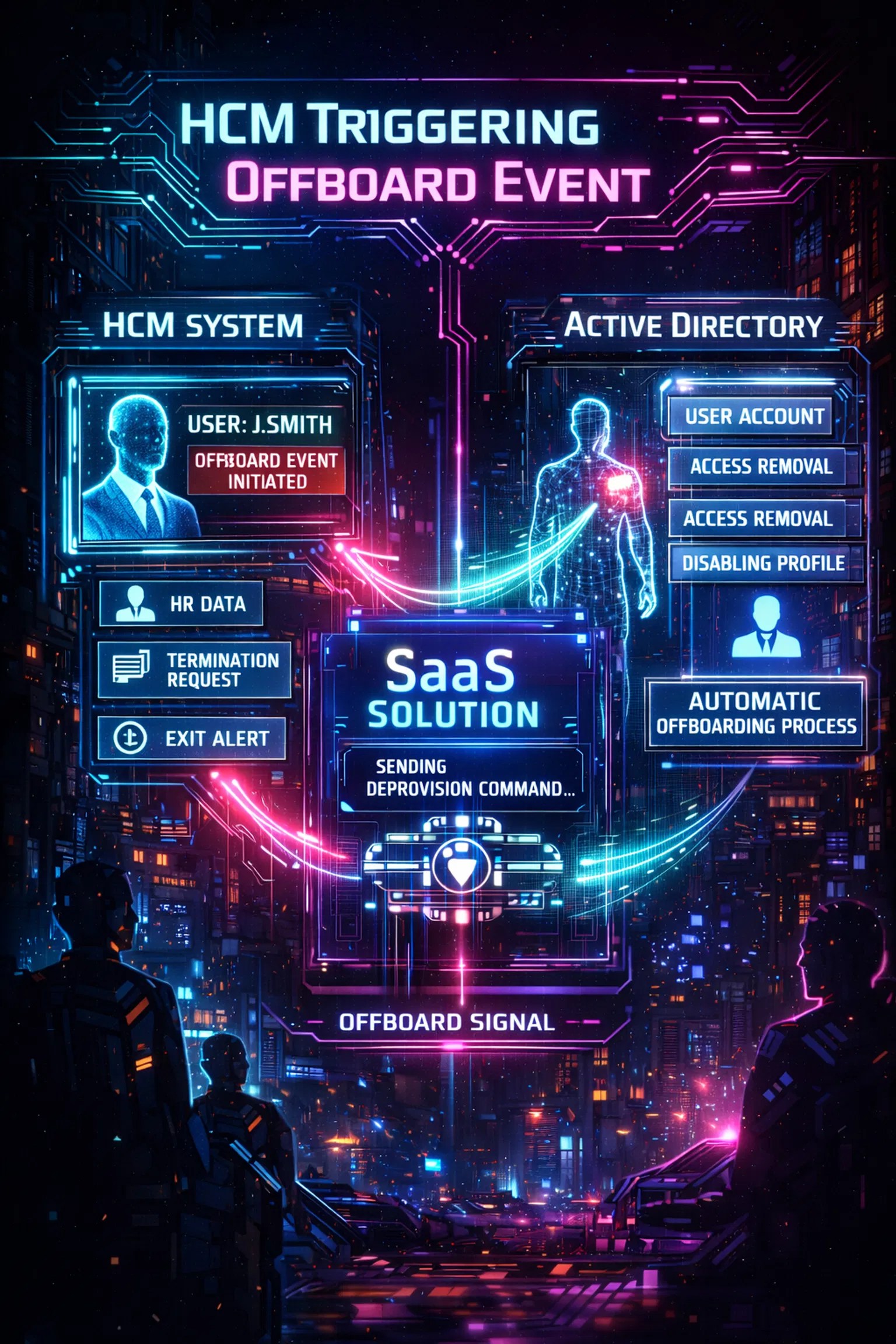
The Human Resources Information System (HRIS or HCM) should be the authoritative trigger for all identity lifecycle events. When a termination date is entered into the HR system, it must automatically initiate the deprovisioning workflow in Entra ID (formerly Azure AD). This eliminates the need for IT tickets that might sit in a queue for days.
2. Immediate Sign-In Blocking and Session Revocation
Disabling an account is insufficient if active sessions are still alive on mobile devices or web browsers. Best practices dictate that the automation must block the user's sign-in and immediately revoke all refresh tokens. This forces the termination of all active sessions across Teams, Outlook, and SharePoint, closing the window of opportunity for data exfiltration.
3. Comprehensive Entitlement Removal
A user’s identity is tied to dozens of groups, licenses, and administrative roles. Automation should handle the removal of the user from security groups and Microsoft 365 groups to ensure they no longer inherit any permissions. Furthermore, licenses should be reclaimed and reallocated to optimize costs, a feature often overlooked in manual processes.
Organizations looking to implement these strategies can explore specific use cases to see how automation scales across different industries and regulatory environments.
How to Automate User Deprovisioning in Microsoft 365
Understanding how to automate user deprovisioning in Microsoft 365 requires a look at the tools available within the Microsoft ecosystem and the gaps they leave behind. While Microsoft Entra ID Lifecycle Workflows provide a foundation, they often require premium P2 licensing and complex configuration that small to mid-market teams may struggle to maintain.
A more streamlined approach involves using a dedicated orchestration platform like Offboarder. The platform acts as a bridge between your HR system and your identity providers. By deploying a lightweight agent, Offboarder can reach into both cloud-native Entra ID environments and legacy on-premise Active Directory domains.
The Technical Workflow:
- HR Integration: The platform monitors the HCM for status changes or specific termination dates.
- Identity Matching: Using flexible identity matching, the system identifies the correct user accounts across multiple domains, even if naming conventions differ.
- Action Execution: Upon the trigger, the platform executes a series of "kill" commands: blocking sign-in, revoking sessions, and removing group memberships.
- Evidence Generation: The platform captures every step of the process in a tamper-resistant format, ready for auditor review.
Automating these steps ensures consistency. Whether an employee leaves on a Monday morning or a Friday evening, the security response is identical and immediate. Consistency is the cornerstone of any defensible compliance posture.
Beyond the "Off" Switch: Audit-Ready Evidence
In the world of compliance, if an action wasn't logged, it didn't happen. Auditors do not want to see a screenshot of a disabled account; they want to see the "why," "when," and "how." They require a trail that connects the HR termination request to the final removal of access.
Manual logs are often incomplete or scattered across different system event viewers. Offboarding logical access removal requires a consolidated audit trail. The Offboarder platform generates comprehensive, exportable artifacts that align with ISO 27001 and SOC 2 requirements. These reports serve as proof of control effectiveness, significantly reducing the time spent on evidence collection during audit season.
Efficient evidence capture allows security teams to focus on proactive threat hunting rather than reactive documentation. It transforms the offboarding process from a clerical burden into a strategic security control.

Scaling Offboarding for the Modern Enterprise
As organizations grow, the complexity of their identity landscape increases. A startup with 50 employees might manage with manual checks, but a mid-market company with 1,000+ employees and multi-domain environments faces a different scale of risk. Technical debt and lean teams make it difficult to maintain a rigorous manual offboarding process.
The platform's cloud-native architecture is designed to handle this complexity. By supporting multi-domain environments and providing built-in WAF protection, it offers a secure and scalable solution for organizations in regulated industries like Healthcare, FinTech, and Education.
Standardizing the offboarding lifecycle reduces operational risk by minimizing manual effort and eliminating the "human error" variable. It ensures that the security team is not the bottleneck in the employee exit process.
For detailed information on how to implement this for your organization, review the pricing options to find a plan that fits your scale and compliance needs.
Turning Activity into Accountability
Automating Microsoft 365 deprovisioning is about more than just IT efficiency. It is about creating a "governance-first" culture where access is treated as a high-stakes asset. By implementing HR-triggered automation, organizations can bridge the gap between their security policies and their operational reality.
The transition from manual to automated offboarding provides:
- Speed: Access is removed in minutes, not days.
- Proof: Automated logs provide clear evidence for SOX and ISO audits.
- Consistency: Every employee is offboarded according to the same rigorous standard.
In a high-stakes regulatory environment, "good enough" is a liability. Precision, speed, and auditable proof must be the standards. Automating your Microsoft 365 offboarding is the most direct path to achieving that standard and securing your organization's digital perimeter.

Leave a Reply