

Startups often prioritize velocity over governance, creating a dangerous friction point in security operations. Privileged Access Management for startups is frequently relegated to the "technical debt" pile, under the assumption that a small team presents a small attack surface. This is a critical misconception.
As organizations scale, the accumulation of unmanaged admin rights, shared credentials, and forgotten service accounts creates a sprawling environment for potential exploitation. Regulatory frameworks like SOC 2 and ISO 27001 require more than just a list of users; they demand proof of control. Failing to implement robust PAM processes early doesn't just invite security risks: it creates a "control gap" that can stall future enterprise deals and audits.
Here are the seven most common mistakes startups make with privileged access and the technical steps required to remediate them.
1. Over-Relying on Manual Offboarding Processes
Many startups manage departures through checklists in Notion or Slack. This manual approach is the primary driver of "ghost access," where terminated employees retain administrative rights for days or even weeks after their exit.
The offboarding logical access removal process must be instantaneous and systematic. Manual handoffs between HR and IT are prone to human error, often resulting in a user being disabled in the Identity Provider (IdP) but remaining active in critical sub-systems like AWS, production databases, or legacy on-prem servers. Organizations should adopt employee offboarding best practices by transitioning to HR-triggered automation that synchronizes termination events across all domains simultaneously.
Automated workflows eliminate the delay between an HR status change and technical access termination.

2. Maintaining "Always-On" Standing Privileges
Granting permanent administrative rights to founders and early engineers is a common convenience that drastically increases the organizational blast radius. If a single developer account is compromised, an attacker gains permanent, high-level access to the entire production environment.
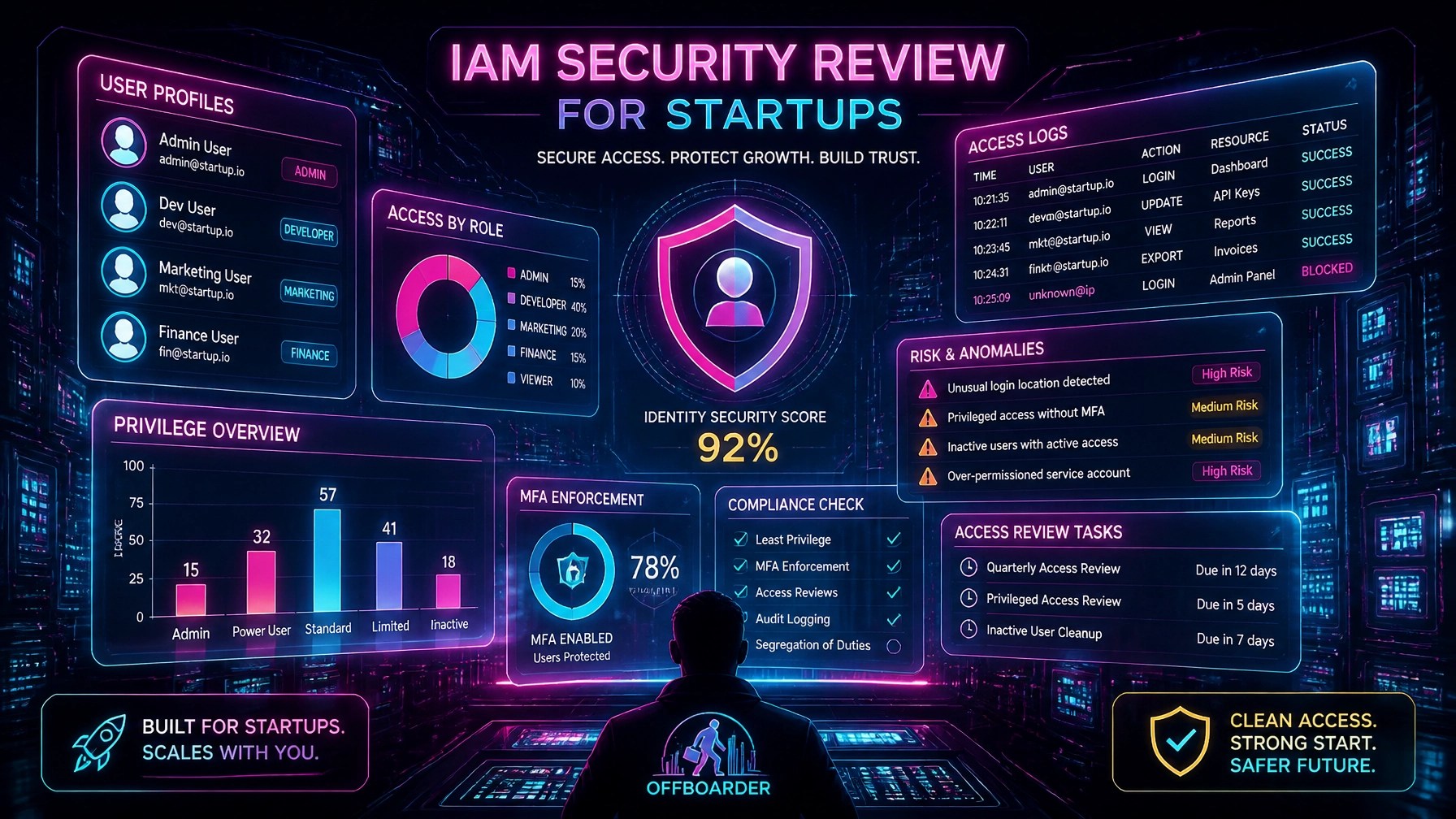
Startups should move toward a "Just-in-Time" (JIT) access model. This involves removing permanent admin roles and requiring users to request elevated permissions only when needed for a specific task. By limiting the duration of elevated access, the window of vulnerability is significantly reduced. This approach is a core component of a modern iam security review for startups aiming for high-maturity security postures.
Transitioning from standing privileges to JIT access minimizes the risk of credential theft.
3. Ignoring the "Shadow Admin" Gap
A common oversight during an iam security review for startups is focusing only on explicit "Admin" roles. In complex environments like Microsoft Entra ID or Okta, users can often accumulate indirect privileges through group memberships or nested roles that effectively grant them administrative power.
Without a centralized visibility tool, these "Shadow Admins" remain invisible to auditors and security managers. Organizations should regularly perform a comprehensive review of all effective permissions: not just assigned roles. This ensures that the principle of least privilege is actually enforced across the entire identity fabric, preventing unauthorized lateral movement during a breach.
Full visibility into effective permissions prevents hidden access paths from bypassing security controls.
4. Neglecting Attack Path Analysis
Most startups view access linearly: User A has Access B. However, attackers view access as a graph of interconnected nodes. An active directory attack path analysis service can reveal how a low-privilege user account might be used to escalate privileges by exploiting misconfigured permissions or cached credentials.
Startups utilizing Microsoft Entra ID or Okta should consider a microsoft entra id red team assessment or an okta red team assessment for startups to identify these hidden trajectories. Understanding how an attacker moves from a compromised workstation to a Domain Admin or Global Admin account is essential for prioritizing remediation efforts.
Mapping potential attack paths allows security teams to break the links that lead to crown jewel assets.

5. Mismanaging Non-Human Identities (Service Accounts)
Startups heavily depend on automation, leading to a proliferation of service accounts and API keys. These non-human identities often have broad, unmonitored privileges and are rarely included in standard offboarding or rotation cycles.
A robust PAM strategy must include a dedicated inventory of all service accounts and machine identities. Credentials for these accounts should be stored in a tamper-resistant vault and rotated automatically. Hardcoding secrets in CI/CD pipelines or configuration files is a high-stakes vulnerability that can lead to total environment compromise.
Securing machine identities is as critical as securing human ones to prevent automated exploitation.
6. Failing to Capture Audit-Ready Evidence
Compliance is not just about doing the work; it is about proving the work was done. For regulated industries, offboarding SOX logical access requirements mandate granular, time-stamped evidence of when and how access was revoked.
Manual screenshots and log exports are insufficient for modern audits. The offboarding process should automatically generate evidence capture reports that correlate HR termination dates with the exact timestamp of account deactivation across all systems. This documentation should be centralized and immutable to ensure it meets the rigorous standards of ISO 27001 and SOC 2 audits.
Automated evidence generation turns compliance from a recurring headache into a background process.
7. Relying on Manual User Deprovisioning Latency
The final mistake is the delay inherent in manual deprovisioning. Knowing how to disable Active Directory user automatically or how to automate user deprovisioning in Microsoft 365 is no longer a luxury; it is a fundamental security requirement.
Relying on an IT administrator to manually log into various consoles to "flip switches" is inherently slow and unscalable. By the time the admin reaches the third or fourth system, a disgruntled former employee could have already exfiltrated sensitive data. Implementing an HR-triggered, automated solution ensures that access is killed across all domains the moment the termination is finalized.
Speed is the most effective defense against post-termination insider threats.

Hardening Your Startup’s PAM Strategy
Privileged Access Management is not a "set it and forget it" project. It requires a consistent, process-driven approach that evolves with the company. Startups must move away from ad-hoc access grants and toward automated, verifiable controls.
By addressing these seven mistakes, organizations can significantly reduce their operational risk and ensure they are ready for the demands of enterprise-grade security and compliance. Whether you are scaling a lean team or preparing for an upcoming audit, the goal is the same: consistency, speed, and proof.
To see how automation can streamline your security operations, explore our use cases or view our pricing to find the right fit for your organization.
Strong governance turns identity management from a vulnerability into a strategic asset.
Leave a Reply