

An ISO 27001 audit is not a test of your intentions; it is a test of your evidence. When an auditor asks for proof of logical access termination, "we usually disable them in Active Directory" is not an acceptable answer. They want to see the specific timestamp, the authoritative trigger, and the corroborating logs across every system the user touched.
Most organizations treat offboarding as a manual checklist managed via email and hope. This creates control gaps that lead to nonconformities and, worse, security vulnerabilities. If your evidence gathering involves digging through sent folders and old Slack messages, you are already behind.
The following seven mistakes are the most common ways companies fail their ISO 27001 offboarding requirements: and how to move toward a tamper-resistant, automated process.
1. The "Scattered Evidence" Trap
The most frequent mistake is failing to centralize evidence. Auditors typically sample a handful of former employees and ask for the full trail: the termination notice, the access removal logs, and the asset return receipt. If these artifacts live in three different systems (HRIS, Jira, and a local spreadsheet), the risk of missing data is high.
Manual collection is a massive time sink. Your team should not spend hours "producing audit evidence for access removal" by taking screenshots of individual AD accounts. This fragmented approach lacks the consistency required for high-stakes compliance.
The Fix: Centralize your offboarding lifecycle. Use a platform that aggregates termination data and technical logs into a single, audit-ready report. Centralization turns a chaotic search into a simple export.
2. The "Timestamp Gap"
ISO 27001 Annex A 6.5 requires that access be revoked "upon termination." Auditors look for the delta between the HR termination date and the actual system disablement. If a user was fired on Friday but their VPN access remained active until Tuesday, you have a significant control gap.
A log that shows an account is "Disabled" is insufficient without a timestamp proving when that status changed. Many legacy systems do not provide an easily accessible history of status changes, making it impossible to prove promptness during an audit.
The Fix: Implement automated user deprovisioning. By linking your HR system directly to your identity provider, you ensure that the millisecond a termination is processed in HR, the access removal command is sent. This creates a definitive, time-stamped record of compliance.
3. The "Ghost Account" Problem in SaaS
Modern businesses run on dozens of SaaS platforms. While Active Directory or Okta might be the primary identity source, many critical systems: like specialized FinTech tools or Healthcare portals: exist as silos. Removing access from the central directory does not always propagate to these standalone accounts.
These "ghost accounts" are an auditor's favorite find. If a leaver can still log into a standalone cloud environment because it wasn't connected to SSO, your iso 27001 offboarding evidence is incomplete. You must prove access was removed everywhere, not just in the "big" systems.
The Fix: For systems that lack native SSO integration, use a dedicated employee offboarding software that can trigger specific deprovisioning workflows across diverse domains. If you are looking for an Okta lifecycle management alternative that handles these edge cases without the enterprise price tag, consider a more agile solution focused specifically on the termination phase.
4. The "Contractor Blind Spot"
ISO 27001 does not distinguish between a full-time employee and a third-party contractor when it comes to security. However, many HR systems only track internal staff. Contractors often have their access managed via manual requests or "until the project ends," which is rarely a hard date.
Failing to apply the same rigorous offboarding controls to contractors is a major vulnerability. If your offboarding process isn't hr triggered, contractors often drift in the system long after their engagement has concluded.
The Fix: Ensure your offboarding platform supports non-HR triggers or manual overrides that follow the same automated workflow as employees. Consistency across all user types is the hallmark of a mature governance program.
5. The "Role Change" Oversight
Access removal isn't just for people leaving the company; it's for people changing roles. When an employee moves from Finance to Marketing, their old permissions should be revoked. This is often called "partial offboarding."
Most companies add new permissions but forget to remove the old ones, leading to privilege creep. During an audit, this shows a lack of "least privilege" enforcement. Your evidence must show that role transitions also triggered a review and removal of unnecessary logical access.
The Fix: Treat role changes as a high-priority event. Use identity governance for startups and mid-market firms to automate the "remove-then-add" process. This ensures that the user's access footprint always matches their current responsibilities.
6. The "HR-IT Communication Void"
The biggest point of failure in the offboarding chain is the manual handoff between HR and IT. If IT relies on an email from HR to start the offboarding process, you are relying on human memory. Humans forget things; automated triggers do not.
This lack of an authoritative trigger makes it impossible to guarantee speed. For companies in regulated industries, "best effort" communication is not a defensible strategy for soc 2 offboarding controls or ISO 27001 compliance.
The Fix: Shift to an HR-triggered offboarding model. The HRIS should be the single source of truth. When the "Status" field changes to "Terminated," the offboarding platform should automatically initiate offboarder logical access termination without waiting for a manual ticket.

7. The "Multi-Domain" Complexity
Large organizations or those with recent acquisitions often struggle with multi domain active directory management. An employee might have accounts across three different domains. If your offboarding script only hits the primary domain, the user remains active in the others.
Providing evidence for multi-domain environments is notoriously difficult. You have to pull logs from multiple controllers and hope they correlate. This is why many organizations seek a SailPoint alternative for small business: they need the power of multi-domain handling without the six-figure implementation cost.
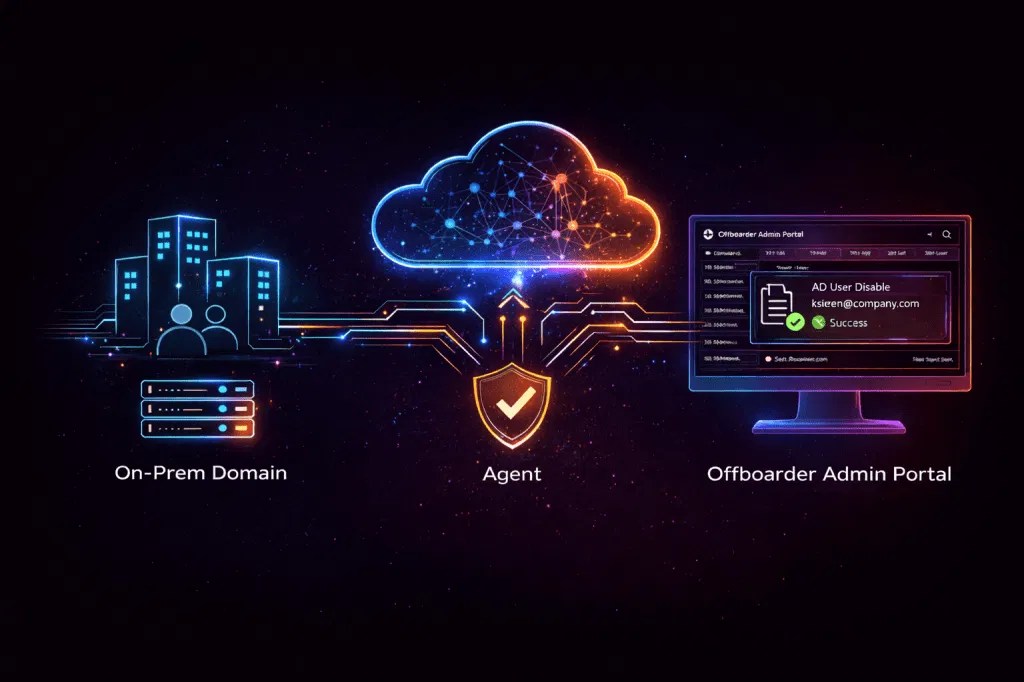
The Fix: Use a lightweight agent that can bridge on-prem domains and cloud directories. This allows for a single command to sweep across all environments, ensuring no account is left behind.
Why "Best Effort" is Not an Option
In the world of cybersecurity, "we tried" is not a defense. The goal of ISO 27001 is to move from ad-hoc processes to a managed, measurable state of security. Automated offboarding is the only way to achieve the consistency that auditors demand.
When you automate, you aren't just saving time; you are creating a tamper-resistant audit trail. Each step of the process is logged, time-stamped, and verified by the system. This turns your annual audit from a week of stress into a ten-minute walkthrough of your automated reports.
Finding the Best Employee Offboarding Software
For mid-market companies, the "big" IAM tools are often too complex and too expensive. You need an affordable IAM solution that focuses on the highest-risk event: termination.
Whether you are managing a single office or complex multi domain active directory environments, the solution must prioritize:
- Speed: Instant access removal upon HR trigger.
- Proof: Immutable logs for every action taken.
- Reach: The ability to hit SaaS, on-prem, and cloud systems.
For more information on how to streamline your compliance journey, explore our Use Cases to see how we help organizations automate their logical access termination. If you're ready to see how automation fits into your budget, visit our Pricing Page.
Automating what is traditionally a complex, multi-team process reduces operational risk and ensures your organization remains audit-ready every single day.
Leave a Reply