
Managing a single Active Directory (AD) domain is a full-time commitment. Managing multiple domains across different forests, regions, or acquired business units is a high-stakes security gamble. For compliance-focused organizations, multi-domain active directory management often becomes the "control gap" that leads to failed SOC 2 or ISO 27001 audits.
When your identity infrastructure is fragmented, consistency disappears. Access removal becomes a manual, error-prone game of "whack-a-mole." If your team is still logging into individual domain controllers to disable users, you are likely making one of the following critical mistakes.
1. Fragmented Visibility: The "Hidden Forest" Problem
The most common mistake in multi-domain environments is the lack of a single source of truth. IT teams often have visibility into the primary corporate domain but lack immediate oversight into legacy domains or those from recent acquisitions.
This visibility gap creates "hidden" accounts. A user might be terminated in the primary domain, but their account in a secondary domain remains active. These orphaned identities are a prime target for lateral movement.
The Fix: You must centralize identity visibility. Implementing a solution that connects to all domains via a lightweight agent ensures that no account is left behind. Centralization turns fragmented data into actionable governance.
2. The Delayed Offboarding Gap
In many organizations, the trigger for offboarding is a manual ticket sent from HR to IT. In a multi-domain setup, this ticket must then be routed to different admins responsible for different domains.
This manual handoff creates a "termination lag." If it takes 24 to 72 hours to revoke access across all domains, you have a significant security vulnerability. Auditors view this delay as a failure of SOC 2 offboarding controls.
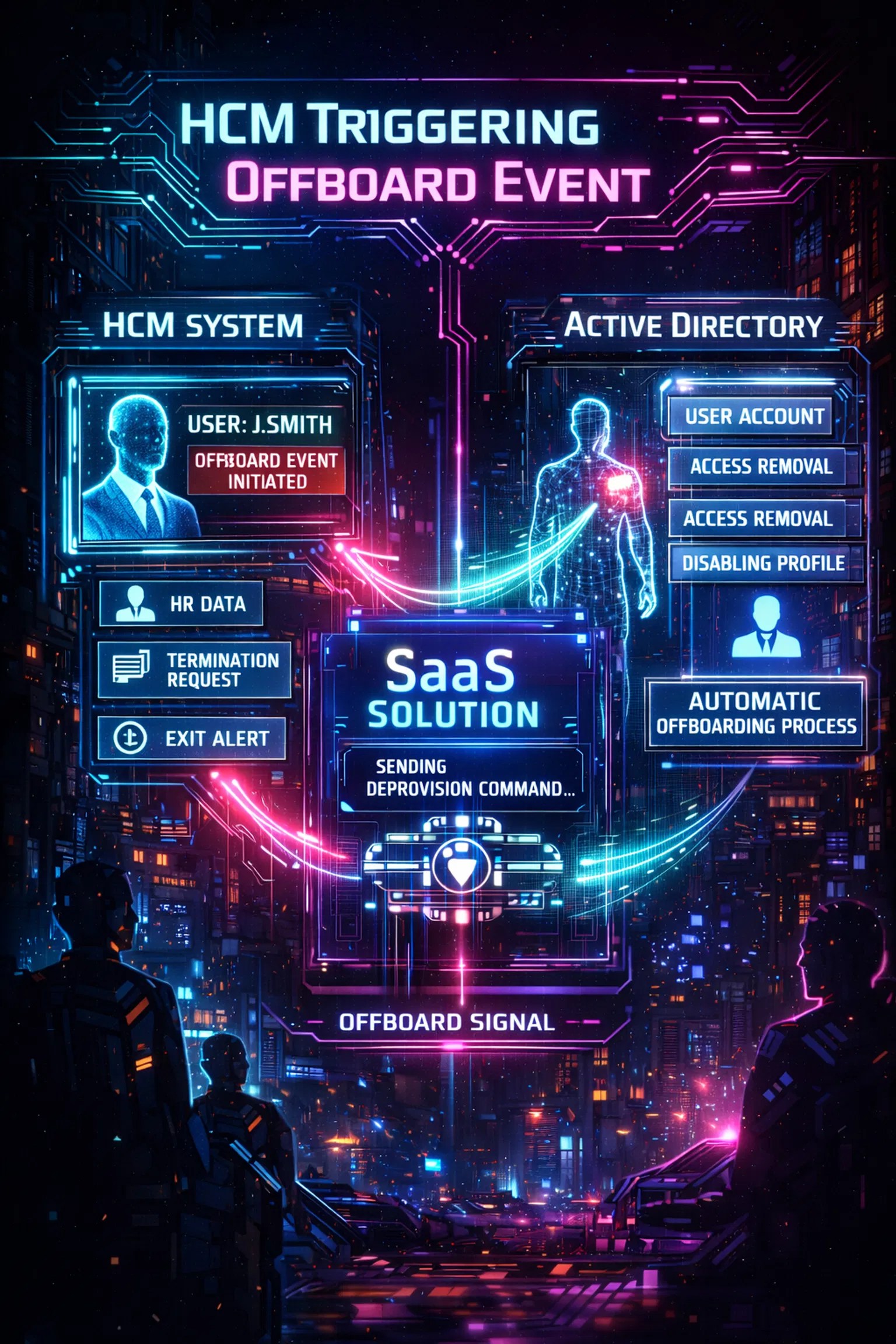
The Fix: Transition to HR-triggered offboarding. The moment an employee's status changes in your HCM (like Workday, Gusto, or BambooHR), a command should automatically propagate to all connected AD domains. Automation eliminates the human delay.

3. Missing Audit Evidence for Compliance
During a SOC 2 or ISO 27001 audit, saying "we disabled the account" is not enough. You must produce audit evidence for access removal that is timestamped, tamper-resistant, and linked to the HR request.
In manual multi-domain environments, "evidence" is often a collection of disparate screenshots from different domain controllers. This is inconsistent and difficult for auditors to verify. It lacks the professional rigor required for modern compliance standards.
The Fix: Use a platform that automatically generates a centralized audit log for every termination. Every action: from disabling the AD account to revoking M365 licenses: should be captured in a single, exportable report. High-quality logging transforms activity into accountability.
4. Over-Privileged Admin "God" Accounts
To manage multiple domains manually, IT staff often require high-level permissions across every forest. These "Domain Admin" or "Enterprise Admin" accounts are high-value targets. If one is compromised, the entire infrastructure is at risk.
The principle of least privilege is frequently sacrificed for the sake of administrative convenience in complex environments. This creates a massive blast radius for any potential breach.
The Fix: Shift to a delegated, automated model. Instead of humans having "God mode" access, use a service like Offboarder that performs specific, scoped actions via a secure agent. This reduces the number of privileged human accounts and strengthens your security posture. Check out our use cases to see how this works in practice.
5. Over-reliance on "Custom" Scripts
Many lean IT teams attempt to solve multi-domain challenges with complex PowerShell scripts. While scripts are powerful, they are often poorly documented and difficult to maintain when the lead engineer leaves.
Scripts also lack the built-in "fail-safe" mechanisms of a dedicated platform. If a script fails to reach a specific domain controller due to a network blip, there is often no alerting or automated retry logic. This results in "partial offboarding," leaving access active in some systems.
The Fix: Replace technical debt with a standardized solution. A dedicated automated user deprovisioning platform provides the reliability and error-handling that home-grown scripts cannot match. Consistency is the foundation of security.
6. Treating Cloud and On-Prem as Separate Entities
Modern identity is hybrid. A common mistake is managing Azure AD (Entra ID) with one process and on-prem AD domains with another. This "split-brain" identity management leads to situations where a user’s cloud access is revoked, but their on-premise credentials: often tied to VPNs or legacy file shares: remain active.
For ISO 27001 offboarding evidence, you must show that access was removed across the entire logical environment, not just the cloud-native bits.
The Fix: Use a platform that treats hybrid identity as a single lifecycle. When a termination is triggered, the system must simultaneously reach out to your cloud IdP and your on-premise domains to ensure complete offboarder logical access termination.
7. Buying "Enterprise Overkill" Tools
Many organizations look at the complexity of multi-domain AD and think their only options are heavy-duty suites like SailPoint or Okta Lifecycle Management. While these are powerful, they are often too expensive and complex for mid-market companies or startups.
These tools require months of implementation and dedicated consultants. For a company with 100 to 5,000 employees, they are often an "enterprise overkill" that drains resources without providing a proportional increase in security.
The Fix: Look for a SailPoint alternative for small business or an Okta lifecycle management alternative that is purpose-built for offboarding. Offboarder offers an affordable IAM solution that delivers audit-ready results without the six-figure price tag or the implementation headache.
Conclusion: Turning Chaos into Control
Multi-domain AD management does not have to be a source of operational risk. By moving away from manual, fragmented processes and embracing HR-triggered automation, you can eliminate the mistakes that compromise security and fail audits.
Standardizing your offboarding process ensures that every departure is handled with the same level of precision, regardless of which domain the user belongs to. In the world of compliance, consistency is your greatest asset.
Ready to automate your multi-domain offboarding?
Explore Offboarder’s pricing and see how we help compliance-focused teams secure their identity lifecycle.
Leave a Reply