

For the modern enterprise, the contractor lifecycle is rarely clean. Projects end, contracts expire, and vendors rotate personnel without a single signal reaching the Identity and Access Management (IAM) stack. This disconnect creates a "standing privilege" problem where departed contractors retain elevated access for weeks or months.
Traditional offboarding programs fail because they rely on static data and passive communication. When an HR record is missing an end date or an automated email goes ignored, the process stalls. This creates a critical control gap that auditors flag and adversaries exploit.
Ava is the communication layer designed to eliminate these stalls. By transforming passive notifications into active, closed-loop conversations, the platform ensures that high-risk access is identified and addressed in days rather than months.
Solving the "Garbage In, Garbage Out" Problem
Most offboarding automation is only as good as the underlying data. If a contractor’s record is missing a departure date or an assigned manager, the automation engine often fails to trigger. This is the "Garbage In" failure mode that leaves privileged accounts active indefinitely.
Ava solves this by actively filling the data gaps. When the Offboarder platform identifies a high-risk contractor with missing metadata, Ava initiates a targeted conversation with the most likely stakeholders.
- Proactive Fact-Finding: Ava reaches out to the contractor or the suspected manager to verify engagement status.
- Structured Data Capture: The responses are parsed and used to enrich the central identity record, providing the deterministic engine with the facts it needs to score risk.
- Stakeholder Verification: Every piece of information gathered is attributed to a specific user, creating a clear line of accountability from the start.
By actively seeking the missing pieces, the platform ensures that "missing data" is no longer a valid reason for a security stall. This proactive enrichment is the first step in achieving significant dwell time reduction.

Real-Time Intelligence vs. The Rubber Stamp
A common failure in compliance programs is the "rubber stamp." Managers receive a list of twenty contractors and, overwhelmed by the volume or lack of context, approve all of them without a second thought. This creates a false sense of security while maintaining high-risk access.
Ava stops the rubber stamp by providing real-time intelligence directly within the communication channel. Instead of a generic link to a portal, Ava delivers an enriched notice that explains exactly why a specific identity is flagged.
- Risk Contextualization: Ava answers questions like "Why is this person high risk?" or "What specific access do they have?" in real time.
- Focused Decision-Making: By providing the "why" alongside the request, Ava empowers managers to make informed decisions rather than blind approvals.
- Conversational Friction: Because the interaction is a dialogue, it requires a higher level of engagement than a simple "Approve All" button, ensuring that high-privileged access receives the scrutiny it requires.
Providing context at the point of decision helps turn a routine administrative task into a meaningful security control.

Ending Silent Stalls with the Escalation Engine
The most dangerous failure mode is the "silent stall." A review request is sent, the manager is out of the office, and the notification sits unread in an inbox while the risk remains live. Without a forced resolution path, these gaps persist until the next audit cycle.
The platform manages this through a rigorous, closed-loop escalation engine. Ava is not just a delivery mechanism; she is the driver of the timeline.
- Direct Reminders: Ava sends persistent, contextual reminders via Slack, Teams, or email as the deadline approaches.
- Skip-Level Escalation: If the primary stakeholder fails to respond within the defined threshold, Ava automatically voices the issue to the next level of leadership.
- Forced Visibility: By moving the conversation from a private inbox to a more visible skip-level channel, the platform ensures that "no response" is not an option.
This structured pressure ensures that every identified risk reaches a conclusion. In a high-stakes environment, visibility is the best deterrent for negligence.

Evidence Capture and Audit-Ready Governance
For CSOs and Compliance Managers, the value of a closed loop is found in the audit trail. A manual offboarding process often leaves a fragmented trail of emails and Slack pings that are impossible to reconstruct during a SOC 2 or ISO 27001 audit.
The platform centralizes every interaction into a single, tamper-resistant record. Every nudge, every question answered by Ava, and every manager response is logged and ready for review.
- Tamper-Resistant Logging: The entire communication history is captured alongside the technical evidence of access removal.
- HMAC-Signed Proof: Final decisions are executed through a secure, PIN-gated flow, ensuring that the person making the call is authenticated and authorized.
- Accountability Reporting: Leadership can view exactly where the bottlenecks are, identifying which departments or managers are consistently slowing down the offboarding lifecycle.
Comprehensive evidence capture helps turn daily security activity into long-term organizational accountability.
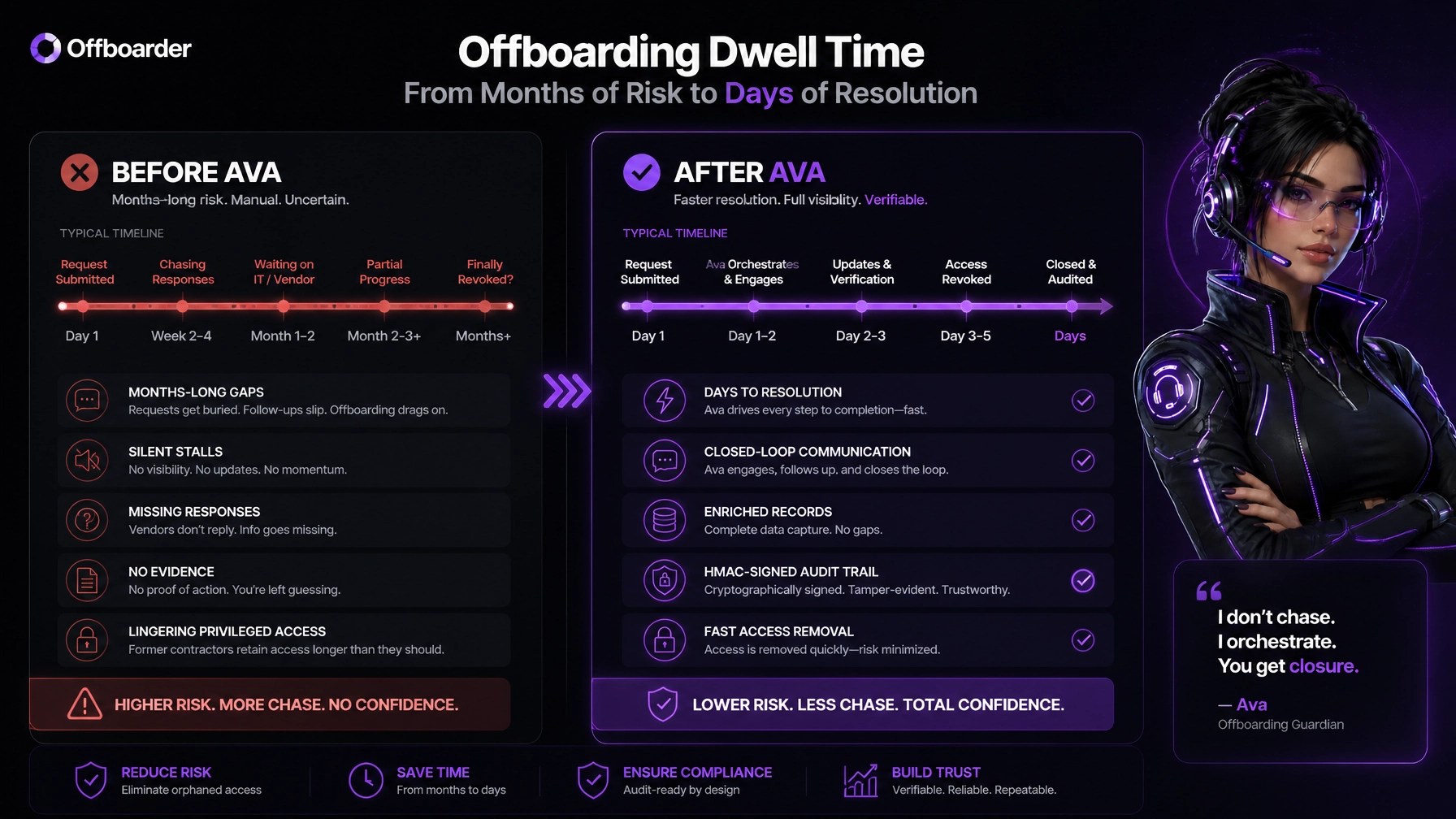
From Months to Days: The Impact on Dwell Time
The ultimate metric for any contractor offboarding solution is dwell time. Every day a privileged account remains active after a contractor's departure is a day of unnecessary risk.
By automating the "find, ask, and escalate" cycle, organizations can move from a reactive posture to a proactive one. What previously took months of manual follow-up is now resolved in a matter of days.
- Operational Consistency: Every contractor is treated with the same level of rigor, regardless of which team they worked for.
- Reduced Risk Surface: Rapid revocation of access significantly narrows the window of opportunity for credential theft or lateral movement.
- Enhanced Compliance: Meeting the strict "timely termination" requirements of modern regulations becomes a byproduct of the process, not an extra burden.
Effective identity governance requires more than just a list of names; it requires a reliable way to close the loop on every identity.
Standardizing the Offboarding Lifecycle
Closing the contractor gap is not a one-time project. It is a continuous process that demands speed, consistency, and proof. The combination of a deterministic risk engine and an active communication layer like Ava provides the framework necessary to manage this risk at scale.
Organizations must stop relying on the hope that managers will remember to submit a ticket. By implementing a closed-loop system, you ensure that the process stays on track even when humans are busy, data is missing, or emails are ignored.
Explore our pricing to see how Offboarder can help your team achieve audit-ready offboarding.
Leave a Reply